
Crystal, Resonator and Oscillators, what’s the difference ?
Today, We are going to discuss about the basic differences between Crystal, Resonator and Oscillator. Most of the people are confused about the fine line of differences between three of them. Let me tell you these 3 are different things for almost same purpose, that purpose is to generate Clock signal of some fixed frequency.
Its not only me, Digikey also stocks these things under 3 different categories…
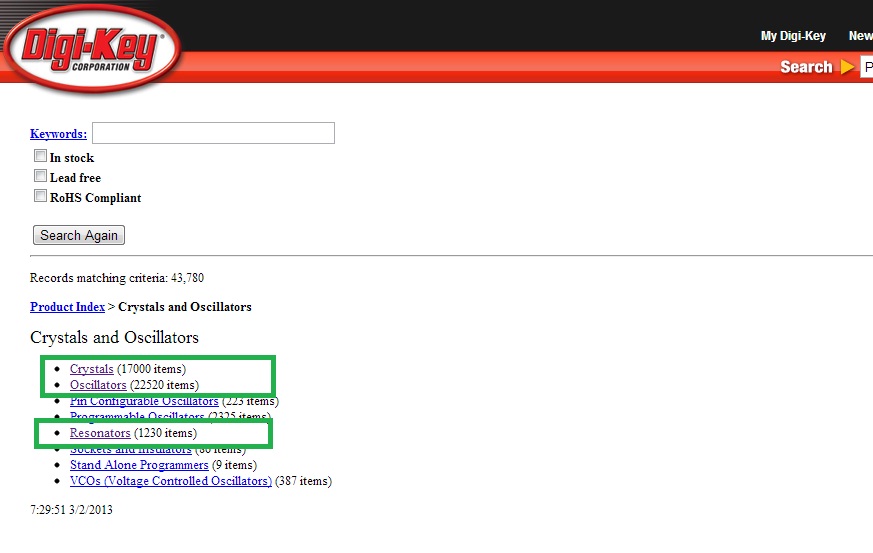
Digikey Listing under Category Crystals & Oscillator
This is what Crystals Looks like at Digikey
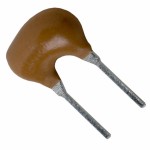
and Finally Resonators at Digikey
So, Visually also they are very different
|
 Oscillator |
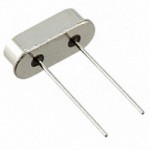 Crystal |
Functionality Wise also they are different, though the purpose is same almost all the time.
- Both ceramic resonators and quartz crystals work on the same principle: the vibrate mechanically when an AC signal is applied to them. Quartz crystals are more accurate and temperature stable than ceramic resonators. Both Quartz Crystal and Ceramic resonator has two legs with no specific pin orientation that means you can solder/plug it into the circuit either way.
- Ceramic Resonator and Quartz Crystal are Passive devices, They are meant to generate clock signals but they alone can not generate Stable clock signal, both of them need some external circuitry around them to sustain oscillations. Like you must have seen the two PF capacitors around Quartz Crystals. On the other hand Clock Oscillators are Active devices and can generate clock independently without and external circuitry.
- Since most of the chips and Micro controllers (which require external clock) have clock stabilization circuitry inside them, So all you need to do is plug in the Quartz Crystal or Resonator of appropriate value in the Two terminal and the Chip itself oscillates the Quartz Crystal or Resonator. The benefit is both Quartz Crystal and Resonator are very Cheap to buy and easily available, While clock oscillators are expensive and not easily available.
- When using clock Oscillator you need not to use OSC_OUT pin of the Micro controller, You can directly feed the output of Clock Oscillator into the OSC_IN pin of the MCU and you are done. No need to tell that Ground must be common.
- Clock generated by clock Oscillator is much more stable than either of Quartz Crystal or Ceramic Resonator.
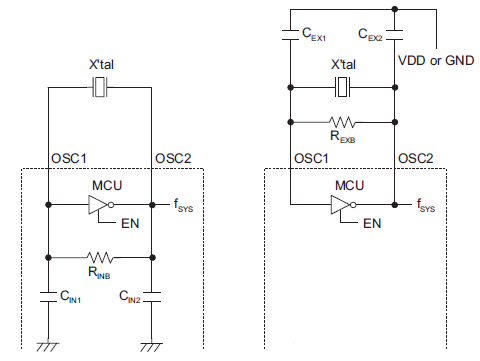
Circuitry inside MCU to support Quartz Crystal or Ceramic Resonator
In Other words, Oscillators are stand alone Clock Generating circuits while Quartz Crystal or Ceramic Resonators are just one part of the whole Oscillator Design. Quartz Crystal or Ceramic Resonator makes an Clock Oscillator when a feedback mechanism is incorporated with them. Like as shown in the Figure above where the feedback circuitry is actually exists inside the MCU itself. This kind of feedback circuit is necessary to achieve sustained oscillations.
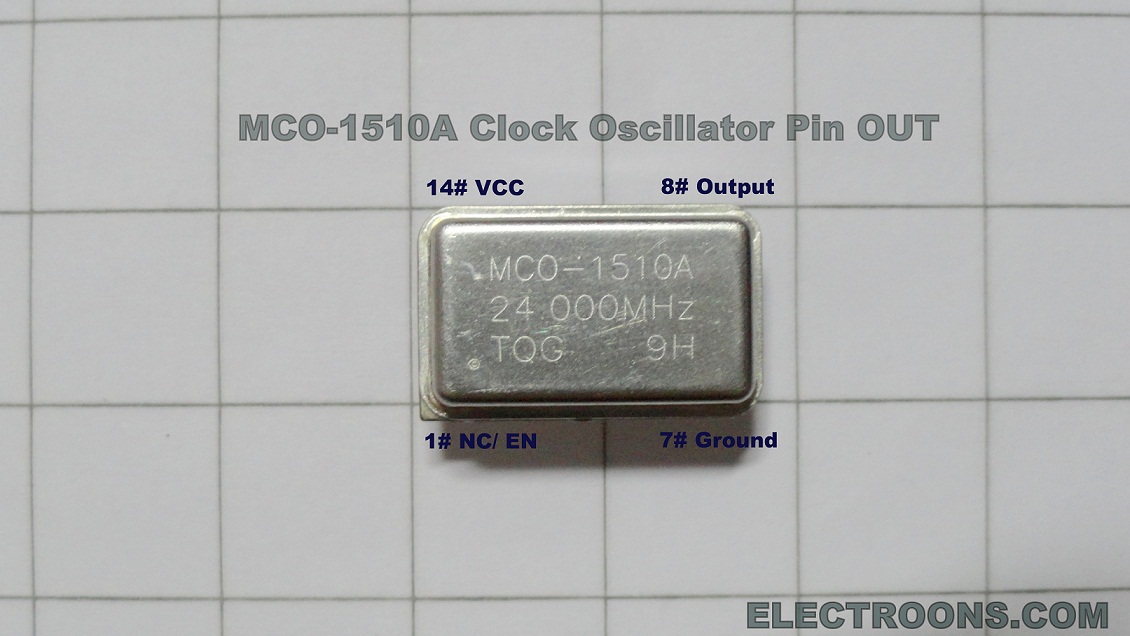
A Clock Oscillator (One with 4 leg metal casing) has a Quartz Crystal as oscillating element and Feedback mechanism and Capacitors for sustained oscillations inside it, which makes it a stand alone clock generator.
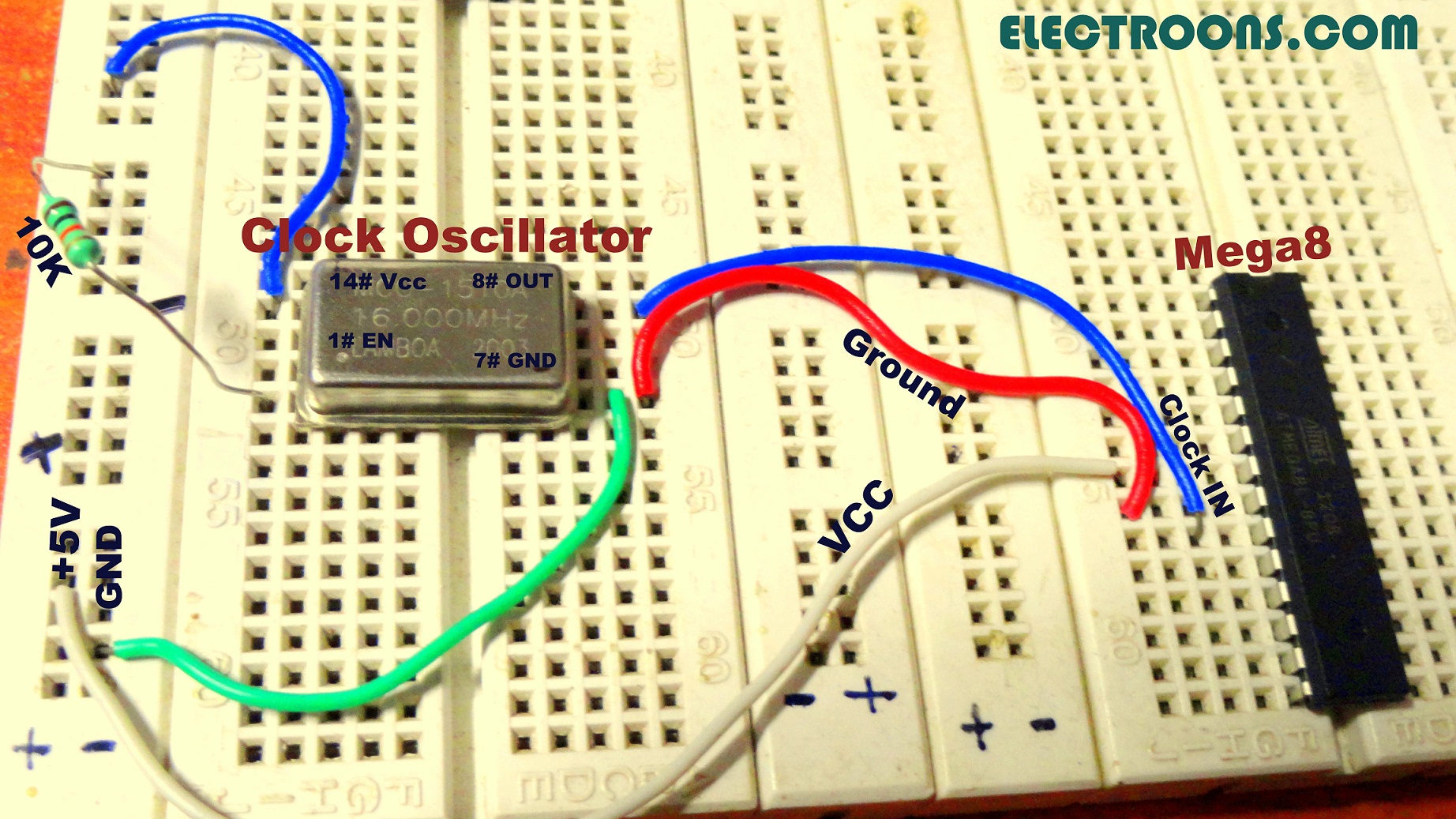
How Clock Oscillator Connects to an Microcontroller
Comments & Responses
2 Responses so far.
Leave a Reply

Recent Posts
- Make In India - What it means to Indian Maker’s Community ?
- Breadboard Power Supplies - Read before you Buy One
- Product Review : Discover Wi-Fi extension board for stm32f4 discovery
- Product Review: OKI78SR-5/1.5 Switching Regulator from muRata Power Solutions
- Product Review - STM8S- Discovery by ST Microelectronics
- Know How : Using GSM Modem - Part 2/2
- Know How : Using GSM Modem - Part 1/2
- ST Microelectronics launches STM32 Nucleo Series
- SW18020P Vibration Switch Testing “Shake Switch”
- TCM8230MD Camera Breakout Board PCB, Can also mount AT45DB Series Flash Memory Chip
- IC Packages of Many Kinds - A comprehensive list
- Keil project setup for STM32F4 Discovery
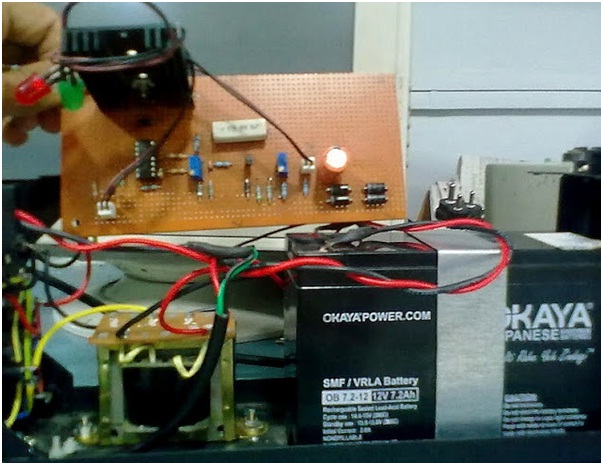
- DIY - 12V 7.2Ah SMF Battery Charger Circuit
- Lonely Night Projects : DIY PMMC and Series Motor Model
- Toys from Trash with Arvind Gupta
- BodyCom Technology by Microchip for Embedded Security & Authentication
- Programmers for Atmel AVR Microcontrollers
- Nikola Tesla - The Greatest Inventor Ever Lived
- Crystal, Resonator and Oscillators, what’s the difference ?
- Pitfalls in STM32 Standard Peripheral Library & Possible Solutions
- Interrupt Driven UART Serial Communication for Atmel AVR
- DIY PICkit2
- What Thomas Edison expected job candidates to know !
- What does ‘AVR’ stands for ?
- Interfacing MCP4725, 12 bit DAC with AVR Microcontroller #avrPrayog
- Interfacing AT93C46 SPI EEPROM with avrPrayog
- How to recover the Unallocated space on Your SD card due to Raspberry Pi OS
- Driving an Alphanumeric LCD with avrPrayog
- Using Arduino/Freeduino as AVR ICSP Programmer
- DoCircuits : Turn your Web Browser into Prototyping Desk
Things You find here
- ADC Interfacing (1)
- Analog Design (4)
- Analog Designs (7)
- Arduino (9)
- ARM Microcontroller (12)
- ARM7 (6)
- Atmel AVR (8)
- Battery Chargers (2)
- Camera Interfacing (1)
- Display (1)
- EAGLE (3)
- EEPROM (2)
- Electrical Enginnering (6)
- Electronics (28)
- General Interest (15)
- General Know How (25)
- GSM Modem (2)
- Hello World (4)
- I2C (2)
- Interfacing Tutorial (15)
- Lonely Night Projects (4)
- LPC21xx (4)
- Make (4)
- mbed (1)
- Microchip (1)
- Microchip PIC (1)
- NXP (4)
- Open Source Ecology (2)
- Open Source Hardware (9)
- PCB Designing (2)
- Physical Computing (5)
- PIC Related (1)
- Power Supply (5)
- Product Review (2)
- Raspberry PI (1)
- Repair Tricks (2)
- SPI (2)
- ST Micro (8)
- STM32 (8)
- STM32F4 Doscovery (8)
- stm8 bit (1)
- Switch Mode Power supply (2)
- Technology (3)
- UART (3)
- Uncategorized (1)
Recently Said
- st1114g on How to recover the Unallocated space on Your SD card due to Raspberry Pi OS
- KpT, on How to recover the Unallocated space on Your SD card due to Raspberry Pi OS
- Neomanderx3 on I2C EEPROM Interfacing with STM32F4 Discovery
- Gábor on DIY PICkit2
- sapher on I2C EEPROM Interfacing with STM32F4 Discovery
- Tonino on DIY PICkit2
- nate on How to recover the Unallocated space on Your SD card due to Raspberry Pi OS
- mahd on TCM8230MD Camera Breakout Board PCB, Can also mount AT45DB Series Flash Memory Chip
- Andrew on How to recover the Unallocated space on Your SD card due to Raspberry Pi OS
- pavan on DIY - 12V 7.2Ah SMF Battery Charger Circuit
Trending Topic
Sponsored

 devesh[at]electroons[dot]com
 +91-9039-035-085

awesome article keep it up the good work

Very well explained subject. I enjoyed reading it.